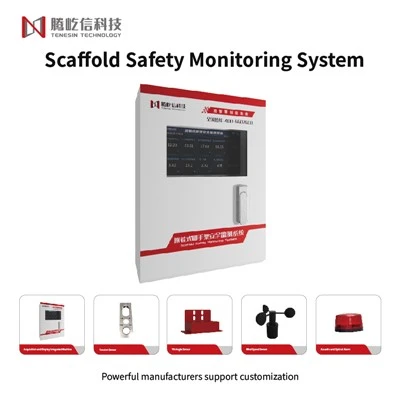
In today's rapidly evolving construction industry, safety stands as a paramount concern. The Form Traveler Safety Monitoring System has emerged as a crucial tool in ensuring the well - being of workers and the smooth operation of construction projects. As a supplier of this system, we are constantly asked whether our Form Traveler Safety Monitoring System complies with industry standards. This blog will delve into this question, providing a comprehensive analysis of the system's compliance and its significance in the construction realm.
Understanding Industry Standards in Construction Safety Monitoring
Before evaluating the compliance of our Form Traveler Safety Monitoring System, it is essential to understand the industry standards that govern safety monitoring systems in construction. These standards are established by various international and national bodies, such as the Occupational Safety and Health Administration (OSHA) in the United States, the European Committee for Standardization (CEN) in Europe, and the International Organization for Standardization (ISO).
These standards typically cover a wide range of aspects, including system accuracy, reliability, data integrity, and user - friendliness. For example, OSHA sets strict guidelines for the maximum allowable loads on construction equipment and the accuracy of monitoring systems in detecting over - loading situations. CEN standards focus on the overall safety and performance of construction machinery, including the requirements for safety monitoring systems to prevent accidents such as collapses and falls. ISO standards, on the other hand, emphasize the quality management and interoperability of safety monitoring systems, ensuring that they can be integrated seamlessly into different construction environments.
Compliance of the Form Traveler Safety Monitoring System
Our Form Traveler Safety Monitoring System is designed and developed with a deep understanding of these industry standards. From the very beginning of the design process, we have incorporated the latest technological advancements to ensure that the system meets or exceeds the requirements set by these regulatory bodies.
Accuracy and Reliability
One of the key aspects of industry standards is the accuracy and reliability of safety monitoring systems. Our Form Traveler Safety Monitoring System utilizes state - of - the - art sensors and data processing algorithms to provide real - time and highly accurate information about the status of the form traveler. These sensors are capable of measuring various parameters, such as load distribution, tilt angle, and vibration, with a high degree of precision.
For instance, the load sensors in our system can detect even the slightest changes in the weight distribution on the form traveler, allowing for early detection of over - loading situations. The tilt sensors can accurately measure the inclination of the form traveler, ensuring that it remains stable during construction operations. The data collected by these sensors is processed in real - time by our advanced algorithms, which can filter out noise and interference to provide reliable and actionable information.
Data Integrity
Data integrity is another critical factor in compliance with industry standards. Our Form Traveler Safety Monitoring System employs a robust data management system to ensure that the data collected by the sensors is accurate, complete, and secure. The system uses encryption techniques to protect the data during transmission and storage, preventing unauthorized access and tampering.
In addition, the system has built - in data validation mechanisms to check the consistency and plausibility of the collected data. If any anomalies are detected, the system will immediately issue an alarm and provide detailed information about the problem, allowing for prompt corrective actions.
User - Friendliness
Industry standards also emphasize the importance of user - friendliness in safety monitoring systems. Our Form Traveler Safety Monitoring System is designed with a user - centric approach, featuring an intuitive graphical user interface (GUI) that allows operators to easily access and interpret the monitoring data.
The GUI provides real - time visualizations of the key parameters, such as load charts, tilt diagrams, and vibration graphs, making it easy for operators to monitor the status of the form traveler at a glance. In addition, the system provides clear and concise alarm messages, indicating the nature and severity of the problems, so that operators can take appropriate actions quickly.
Comparison with Other Safety Monitoring Systems
To further illustrate the compliance of our Form Traveler Safety Monitoring System, it is useful to compare it with other similar systems in the market, such as the Unloading Platform Safety Monitoring System and the Suspended Platform Safety Monitoring System.
While these systems also play important roles in construction safety monitoring, our Form Traveler Safety Monitoring System has several unique features that set it apart. For example, our system is specifically designed for form travelers, taking into account the unique structural and operational characteristics of these equipment. This means that the system can provide more accurate and relevant monitoring information, tailored to the specific needs of form traveler operations.
In addition, our system has a higher level of integration and interoperability, allowing it to be easily integrated with other construction management systems. This enables seamless data sharing and communication between different systems, improving the overall efficiency and effectiveness of construction project management.
Significance of Compliance in the Construction Industry
Compliance with industry standards is not only a legal requirement but also a moral obligation for companies in the construction industry. By using a compliant Form Traveler Safety Monitoring System like ours, construction companies can significantly reduce the risk of accidents and ensure the safety of their workers.
Accidents on construction sites can have serious consequences, including injuries, fatalities, and property damage. These accidents can also lead to project delays, cost overruns, and damage to the company's reputation. A compliant safety monitoring system can help construction companies to identify and address potential safety hazards in a timely manner, preventing accidents from occurring and minimizing their impact.
In addition, compliance with industry standards can also enhance the competitiveness of construction companies. In today's highly competitive construction market, clients are increasingly demanding that construction projects are carried out in a safe and compliant manner. By using a compliant Form Traveler Safety Monitoring System, construction companies can demonstrate their commitment to safety and quality, giving them a competitive edge in the market.
Conclusion
In conclusion, our Form Traveler Safety Monitoring System is fully compliant with industry standards. Through its high - level accuracy, reliability, data integrity, and user - friendliness, the system provides a comprehensive solution for ensuring the safety of form traveler operations. Compared with other similar systems in the market, our system offers unique advantages that are tailored to the specific needs of form traveler applications.
If you are in the construction industry and are looking for a reliable and compliant Form Traveler Safety Monitoring System, we encourage you to contact us for further discussion and potential procurement. You can visit our website Form Traveler Safety Monitoring System for more detailed information about our product. Our team of experts is ready to provide you with professional advice and support to ensure that you find the best safety monitoring solution for your construction projects.


References
- Occupational Safety and Health Administration (OSHA). Regulations and standards related to construction safety.
- European Committee for Standardization (CEN). Standards for construction machinery and safety monitoring systems.
- International Organization for Standardization (ISO). Quality management and interoperability standards for safety monitoring systems.