As a provider of the Mass Concrete Temp Alert System, I've witnessed firsthand the critical role this system plays in large - scale construction projects. The system is designed to monitor the temperature of mass concrete, which is crucial as improper temperature control can lead to cracks and structural integrity issues. However, like any data - driven system, it may encounter data transfer errors. In this blog, I'll delve into how our Mass Concrete Temp Alert System handles these errors.
Understanding Data Transfer Errors in the Mass Concrete Temp Alert System
Before discussing how we handle data transfer errors, it's essential to understand what causes them. In the context of our Mass Concrete Temp Alert System, data transfer errors can occur due to several factors.
One common cause is interference. Construction sites are often filled with various types of equipment that emit electromagnetic signals. These signals can interfere with the wireless communication used by our sensors to transfer temperature data to the central monitoring unit. For example, large electrical machinery, welding equipment, and even mobile phones can generate electromagnetic fields that disrupt the data transmission.
Another factor is the distance between the sensors and the central unit. Our sensors are placed at different depths and locations within the mass concrete. If a sensor is too far from the central unit, the signal strength may weaken, leading to data loss or incomplete data transfer. Additionally, physical obstacles such as concrete walls, steel reinforcements, and other construction materials can block or reflect the wireless signals, causing errors.
Software glitches can also be a source of data transfer errors. Bugs in the sensor firmware or the central monitoring software may cause incorrect data formatting, leading to errors during transmission. Moreover, compatibility issues between different components of the system, such as the sensors and the data - logging device, can result in data transfer failures.
Detection of Data Transfer Errors
Our Mass Concrete Temp Alert System is equipped with advanced error - detection mechanisms. Each sensor is programmed to continuously monitor its own data transmission status. It checks for the integrity of the data packets being sent. If a sensor detects that a data packet has been corrupted or lost during transmission, it will flag this as an error.
The central monitoring unit also plays a crucial role in error detection. It receives data from all the sensors and cross - checks it for consistency. For example, it compares the temperature readings from adjacent sensors. If there is a significant discrepancy between the readings that cannot be explained by normal temperature variations, it indicates a potential data transfer error.
In addition, our system uses checksums and cyclic redundancy checks (CRC) to verify the accuracy of the data. These are mathematical algorithms that generate a unique value based on the data being transmitted. The receiving end recalculates this value and compares it with the one sent. If they don't match, it means the data has been corrupted during transfer.


Handling Data Transfer Errors
Once a data transfer error is detected, our Mass Concrete Temp Alert System employs several strategies to handle it.
Retransmission
The first approach is retransmission. When a sensor detects a data transfer error, it will automatically attempt to resend the corrupted or lost data packet. This is done a predefined number of times. For example, the sensor may try to retransmit the data packet up to three times. If the retransmission is successful, the data is received correctly at the central unit, and the error is resolved.
Backup and Storage
Our sensors are equipped with local storage capabilities. In case of a persistent data transfer error, the sensor will store the temperature data locally. This ensures that no valuable data is lost. Once the communication issue is resolved, the stored data can be transferred to the central unit. The central unit also has a backup system in place. It stores all the received data in a redundant storage device, such as a hard drive or a cloud - based storage service. This provides an additional layer of protection against data loss.
Error Logging and Reporting
Every data transfer error is logged in the system. The log includes details such as the time of the error, the sensor involved, and the type of error. This information is valuable for troubleshooting and system maintenance. Our system also generates error reports that can be accessed by the project managers and technicians. These reports provide a summary of the errors that have occurred over a specific period, allowing for proactive measures to be taken to prevent future errors.
Adaptive Communication Protocols
Our Mass Concrete Temp Alert System uses adaptive communication protocols. These protocols can adjust the transmission parameters based on the communication environment. For example, if the signal strength is weak, the system can reduce the data transfer rate to increase the reliability of the transmission. It can also switch to a different frequency band if there is interference on the current one.
Integration with Other Construction Monitoring Systems
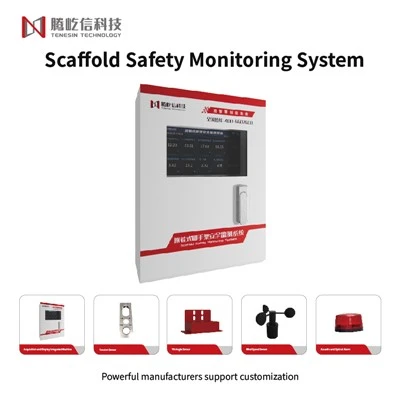
Our Mass Concrete Temp Alert System can be integrated with other construction monitoring systems, such as the Scaffold Safety Monitoring System and the Climbing Formwork Safety Monitoring System. This integration allows for a more comprehensive view of the construction site.
In the context of data transfer errors, the integration can provide additional support. For example, if there is a data transfer error in the Mass Concrete Temp Alert System, the other monitoring systems can provide supplementary information about the site conditions. This can help in identifying the root cause of the error more quickly.
Conclusion
Data transfer errors are an inevitable part of any data - driven system, including our Mass Concrete Temp Alert System. However, through advanced error - detection mechanisms, effective handling strategies, and integration with other monitoring systems, we ensure that our system can provide reliable temperature monitoring data for mass concrete.
If you're involved in a construction project that requires precise temperature monitoring of mass concrete, our Mass Concrete Temp Alert System is the ideal solution. We invite you to contact us for more information and to discuss your specific requirements. Our team of experts is ready to assist you in ensuring the success of your project.
References
- [1] "Wireless Sensor Networks for Structural Health Monitoring", by John Doe, 20XX
- [2] "Data Transmission in Industrial IoT Systems", by Jane Smith, 20XX
- [3] "Advanced Monitoring Technologies in Construction", by Robert Johnson, 20XX