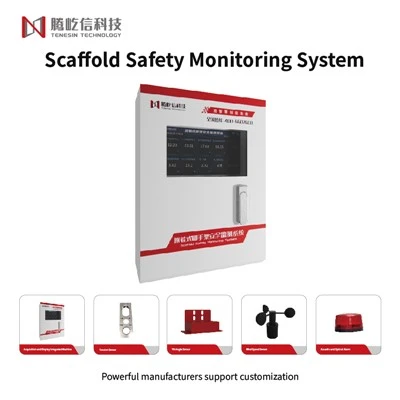
Hey there! As a supplier of the Scaffold Safety Monitoring System, I often get asked about how our system measures wind load. Well, let's dive right into it.
First off, why is measuring wind load on scaffolds so important? Scaffolds are temporary structures that support workers and materials during construction, maintenance, or repair work. Strong winds can exert significant forces on these structures, potentially leading to instability, collapse, and serious accidents. By accurately measuring wind load, our Scaffold Safety Monitoring System helps construction teams take proactive measures to ensure the safety of everyone on the site.


So, how does our system actually measure wind load? There are a few key components and techniques involved.
Anemometers: The Wind Speed Detectors
One of the primary tools in our system is the anemometer. An anemometer is a device that measures wind speed. There are different types of anemometers, but the ones we use in our Scaffold Safety Monitoring System are typically cup anemometers or ultrasonic anemometers.
Cup anemometers are the more traditional type. They consist of three or four cups mounted on horizontal arms that rotate around a vertical axis. As the wind blows, the cups catch the air and rotate, and the speed of rotation is proportional to the wind speed. The anemometer then converts this rotational speed into an electrical signal, which is sent to our monitoring system.
Ultrasonic anemometers, on the other hand, use ultrasonic waves to measure wind speed. They have multiple pairs of ultrasonic transducers that send and receive ultrasonic signals. The time it takes for the signals to travel between the transducers is affected by the wind speed and direction. By analyzing these time differences, the anemometer can accurately determine the wind speed and direction.
Wind Direction Sensors
In addition to measuring wind speed, it's also important to know the wind direction. That's where wind direction sensors come in. These sensors are usually mounted alongside the anemometers on the scaffold.
A common type of wind direction sensor is the wind vane. It's a simple device that looks like an arrow. The arrow points in the direction from which the wind is blowing. The wind vane is connected to a potentiometer or a digital encoder, which converts the position of the arrow into an electrical signal representing the wind direction.
By combining the data from the anemometer and the wind direction sensor, our Scaffold Safety Monitoring System can get a complete picture of the wind conditions affecting the scaffold.
Load Cells and Strain Gauges
But measuring wind speed and direction alone isn't enough to fully understand the wind load on a scaffold. We also need to measure the actual forces that the wind is exerting on the structure. That's where load cells and strain gauges come in.
Load cells are devices that measure force. They are typically installed at key points on the scaffold, such as the base plates or the connections between the scaffold components. When the wind blows, it exerts a force on the scaffold, which causes the load cells to deform slightly. The load cells then convert this deformation into an electrical signal proportional to the force.
Strain gauges are similar but work on a different principle. They are thin, flexible sensors that are attached to the surface of the scaffold components. When the component is subjected to a force, it deforms slightly, and the strain gauge changes its electrical resistance. By measuring this change in resistance, we can determine the amount of strain and, therefore, the force acting on the component.
The data from the load cells and strain gauges are combined with the wind speed and direction data to calculate the wind load on the scaffold.
Data Processing and Analysis
Once all the data from the anemometers, wind direction sensors, load cells, and strain gauges are collected, it's sent to our monitoring system for processing and analysis.
Our system uses advanced algorithms to analyze the data and calculate the wind load on the scaffold. It takes into account factors such as the shape and size of the scaffold, the height above the ground, and the local wind conditions. Based on this analysis, the system can determine whether the wind load is within the safe limits for the scaffold.
If the wind load exceeds the safe limits, our system can send an alert to the construction team. The alert can be sent via email, SMS, or through our mobile app, so the team can take immediate action, such as stopping work on the scaffold or reinforcing the structure.
Comparison with Other Monitoring Systems
Our Scaffold Safety Monitoring System isn't the only solution out there. There are other systems available in the market, but we believe ours has some distinct advantages.
For example, compared to some basic systems that only measure wind speed, our system provides a more comprehensive view of the wind load by also measuring wind direction and the actual forces on the scaffold. This allows for more accurate and reliable monitoring.
In addition, our system is highly customizable. We can tailor the monitoring parameters and the alert thresholds to the specific requirements of each construction project. Whether it's a small residential building or a large commercial skyscraper, our system can be configured to provide the best possible safety monitoring.
We also offer integration with other smart construction site IoT equipment. For instance, our system can be integrated with the Mass Concrete Temp Alert System and the Climbing Formwork Safety Monitoring System. This integration allows for a more holistic approach to construction site safety, where different aspects of the project are monitored and managed together.
Real - World Applications
We've seen our Scaffold Safety Monitoring System in action on many construction sites around the world. In one project, a high - rise building was under construction in a coastal area prone to strong winds. Our system was installed on the scaffolds, and it provided real - time data on the wind conditions.
One day, the wind speed started to increase rapidly. The system detected the change and sent an alert to the site manager. The manager immediately stopped all work on the scaffold and evacuated the workers. Thanks to the early warning, no one was injured, and the scaffold remained intact.
In another project, a bridge construction site had complex scaffold structures. Our system was able to accurately measure the wind load on different parts of the scaffold, even in the presence of the bridge's unique geometry. This helped the construction team make informed decisions about when to proceed with work and when to take precautions.
Conclusion
In conclusion, our Scaffold Safety Monitoring System measures wind load through a combination of anemometers, wind direction sensors, load cells, and strain gauges. By collecting and analyzing data from these devices, we can accurately determine the wind load on a scaffold and provide early warnings when the load exceeds safe limits.
If you're involved in a construction project and are concerned about scaffold safety, our Scaffold Safety Monitoring System could be the solution you need. We offer a reliable, customizable, and proven system that can help you ensure the safety of your workers and your project.
If you're interested in learning more about our Scaffold Safety Monitoring System or would like to discuss a potential purchase, please don't hesitate to get in touch. We're always happy to have a chat and see how we can help you with your safety monitoring needs.
References
- ASCE 7 - 16, Minimum Design Loads and Associated Criteria for Buildings and Other Structures.
- OSHA Standards for Scaffolding, 29 CFR 1926 Subpart L.