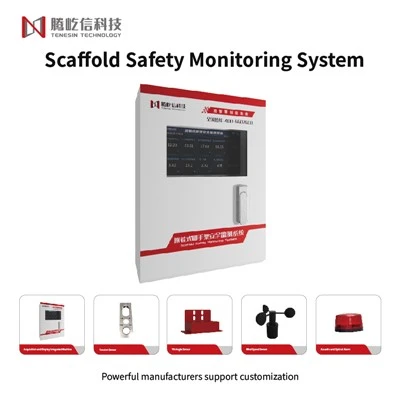
As a supplier of Construction Hoist Safety Monitoring Systems, I've witnessed firsthand the diverse landscape of construction hoist designs and the crucial need for our systems to adapt effectively. In this blog, I'll delve into how our systems are engineered to fit various construction hoist designs, ensuring safety and efficiency across the board.
Understanding the Diversity of Construction Hoist Designs
Construction hoists come in a wide array of designs, each tailored to specific construction needs. Some are small, portable hoists used for minor building projects, while others are large, permanent installations on high - rise construction sites. The differences in design can be significant, including variations in load capacity, lifting speed, height, and the type of control system.
For instance, a simple single - mast hoist may have a relatively straightforward design with a limited load capacity, typically used for transporting light materials and a few workers. On the other hand, a multi - mast hoist with a high - speed lifting mechanism is designed for large - scale construction projects where heavy loads need to be moved quickly to great heights. These differences pose unique challenges for safety monitoring systems, as they must be able to accurately assess and respond to the specific risks associated with each design.
Key Adaptation Strategies
Modular Design
Our Construction Hoist Safety Monitoring System features a modular design, which is one of the most effective ways to adapt to different hoist designs. The system is composed of individual modules that can be easily combined or removed depending on the requirements of the hoist. For example, for a small - scale hoist with basic safety needs, we can provide a core module that monitors essential parameters such as load weight and height. This module can be installed quickly and cost - effectively.


For more complex hoist designs, additional modules can be added. These may include modules for monitoring acceleration, vibration, and door interlocks. The modular approach allows us to customize the system for each hoist, ensuring that it provides comprehensive safety monitoring without unnecessary complexity or cost.
Adjustable Sensors
Another important adaptation strategy is the use of adjustable sensors. Our sensors are designed to be highly flexible, allowing them to be calibrated to different hoist specifications. For example, the load sensor can be adjusted to measure different load ranges, from a few hundred kilograms to several tons. This is crucial because different hoist designs have different load - bearing capacities, and the sensor must be able to accurately measure the load within the specific range of the hoist.
Similarly, the height sensor can be adjusted to account for different hoist heights. Whether it's a short - height hoist used in a low - rise building or a tall hoist for a skyscraper, the sensor can be set to provide accurate height measurements. This ensures that the safety monitoring system can detect any abnormal height changes, such as over - hoisting or under - hoisting, which could lead to serious accidents.
Compatibility with Different Control Systems
Construction hoists can be equipped with various control systems, including manual, semi - automatic, and fully automatic controls. Our Safety Monitoring System is designed to be compatible with all these types of control systems. It can interface with the hoist's existing control system to receive and transmit data, allowing for seamless integration.
For example, in a manual control system, the monitoring system can provide real - time feedback to the operator, alerting them to any safety issues such as overloading or abnormal movement. In a semi - automatic or fully automatic control system, the monitoring system can communicate directly with the control unit to adjust the hoist's operation if necessary. This compatibility ensures that the safety monitoring system can work effectively regardless of the hoist's control mechanism.
Case Studies
Adaptation to a Small - Scale Portable Hoist
We recently worked on a project involving a small - scale portable hoist used in a residential construction site. The hoist had a relatively low load capacity and was mainly used for transporting light building materials. Our team installed a basic modular safety monitoring system that included a load sensor and a height sensor. The sensors were calibrated to the specific load and height range of the hoist.
The system was easy to install and did not require any major modifications to the hoist. It provided real - time monitoring of the load and height, and if the load exceeded the safe limit or the hoist reached an abnormal height, an alarm would sound. This simple yet effective solution ensured the safety of the workers and the proper operation of the hoist.
Integration with a Large - Scale Multi - Mast Hoist
In another project, we were tasked with integrating our safety monitoring system with a large - scale multi - mast hoist used in a high - rise construction project. This hoist had a high load capacity, high - speed lifting mechanism, and a complex control system.
We used a combination of multiple modules, including sensors for acceleration, vibration, and door interlocks, in addition to the standard load and height sensors. The system was carefully calibrated to the hoist's specifications and was integrated with the hoist's automatic control system. This allowed the monitoring system to communicate directly with the control unit, enabling real - time adjustments to the hoist's operation. For example, if the acceleration sensor detected an abnormal acceleration, the system could automatically reduce the hoist's speed to prevent accidents.
The Role of Technology in Adaptation
Advanced Algorithms
Our Construction Hoist Safety Monitoring System utilizes advanced algorithms to analyze the data collected from the sensors. These algorithms are designed to adapt to different hoist designs by taking into account the specific characteristics and operating conditions of each hoist. For example, the algorithm can distinguish between normal and abnormal vibrations based on the hoist's design and load. This helps in accurately detecting potential safety issues and reducing false alarms.
Internet of Things (IoT) Connectivity
The integration of IoT technology in our safety monitoring system allows for remote monitoring and management. Regardless of the hoist's location or design, the system can transmit data to a central server, where it can be accessed by our technical support team and the construction site managers. This enables real - time monitoring of the hoist's safety status, and if any issues are detected, immediate action can be taken.
For example, if the monitoring system detects an abnormal load on a hoist located in a remote construction site, the technical support team can remotely analyze the data and provide guidance to the on - site operators. This IoT connectivity also allows for software updates to be pushed to the monitoring system, ensuring that it always has the latest safety features and adaptations.
Conclusion
In conclusion, our Construction Hoist Safety Monitoring System is designed to adapt to different construction hoist designs through a combination of modular design, adjustable sensors, compatibility with different control systems, advanced algorithms, and IoT connectivity. These adaptation strategies ensure that the system can provide comprehensive safety monitoring for hoists of all sizes and complexities.
If you are in the market for a reliable and adaptable Construction Hoist Safety Monitoring System, we invite you to [Contact us for procurement and negotiation](Construction Hoist Safety Monitoring System). Our team of experts will work closely with you to understand your specific hoist design and requirements, and provide you with a customized solution that meets your safety needs.
References
- "Safety Standards for Construction Hoists", International Construction Safety Association
- "Advances in Construction Hoist Technology", Journal of Construction Engineering and Management
- "IoT - Enabled Safety Monitoring Systems for Construction Equipment", Proceedings of the International Conference on Construction Technology