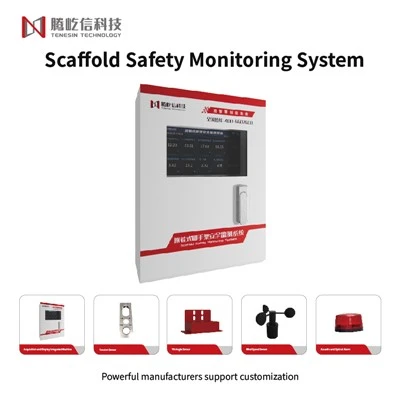
In the realm of construction safety, the Unloading Platform Safety Monitoring System stands as a crucial safeguard, ensuring the well - being of workers and the integrity of operations. One question that often arises among our clients is whether this system can work during power outages. As a leading supplier of the Unloading Platform Safety Monitoring System, I am here to delve into this topic and provide a comprehensive answer.
The Importance of Unloading Platform Safety Monitoring
Before we address the power outage issue, let's first understand why the Unloading Platform Safety Monitoring System is so vital. Construction sites are dynamic environments with a constant flow of materials in and out of unloading platforms. These platforms are subject to various risks, such as overloading, uneven loading, and structural instability. The Unloading Platform Safety Monitoring System is designed to detect these potential hazards in real - time. It monitors parameters like weight distribution, platform tilt, and the integrity of structural components. By doing so, it helps prevent accidents such as platform collapses, which can lead to serious injuries or even fatalities.
How the System Operates Under Normal Conditions
Under normal power supply, the Unloading Platform Safety Monitoring System functions seamlessly. It consists of a network of sensors strategically placed on the unloading platform. These sensors continuously collect data on various safety - related parameters. The data is then transmitted to a central control unit, which processes the information and provides real - time feedback. If any abnormal conditions are detected, the system can trigger alarms, both audible and visual, to alert workers on the site. Additionally, it can be integrated with other safety systems on the construction site, enabling a coordinated response to potential safety threats.
Challenges During Power Outages
Power outages are an inevitable part of any construction project, whether due to grid failures, equipment malfunctions, or natural disasters. When the power goes out, the primary concern is whether the Unloading Platform Safety Monitoring System can still perform its essential functions. The sensors rely on electrical power to operate, and without it, they cannot collect data. Similarly, the central control unit, which processes and analyzes the data, also requires power to function.
Solutions for Power - Outage Resilience
To address the issue of power outages, our Unloading Platform Safety Monitoring System is equipped with several features to ensure continuous operation.
Battery Backup
One of the most straightforward solutions is the inclusion of a battery backup system. The sensors and the central control unit are connected to high - capacity batteries that can provide power for a limited period. These batteries are designed to automatically kick in when the main power supply fails. The duration of backup power depends on the battery capacity and the power consumption of the system. In our systems, the battery backup can typically support the operation of the monitoring system for several hours, which is usually sufficient to handle most short - term power outages.
Energy - Harvesting Technologies
In addition to battery backup, we are also exploring the use of energy - harvesting technologies. For example, some of our sensors are equipped with solar panels. These solar panels can convert sunlight into electrical energy, which can be used to power the sensors. This is particularly useful for outdoor construction sites where sunlight is readily available. Another form of energy harvesting is kinetic energy harvesting. Some sensors are designed to capture the kinetic energy generated by the movement of the unloading platform itself, such as vibrations and mechanical stresses. This energy can then be converted into electrical energy to power the sensors.
Redundancy in Communication
During a power outage, communication is crucial. Our system is designed with redundant communication channels. In addition to the wired communication network, which may be affected by the power outage, we also incorporate wireless communication options. For example, the system can use cellular networks or Wi - Fi to transmit data. These wireless communication channels can be powered by the battery backup system, ensuring that the data can still be transmitted to a remote monitoring center even during a power outage.
Case Studies
To illustrate the effectiveness of our solutions, let's look at some real - world case studies. In a large - scale construction project in a remote area, there was a sudden power outage due to a severe storm. The Unloading Platform Safety Monitoring System, equipped with a battery backup, continued to operate for over three hours. During this time, the system detected a slight tilt in the unloading platform, which was likely caused by the strong winds. The system triggered an alarm, alerting the workers on the site. Thanks to the early warning, the workers were able to take immediate action to stabilize the platform, preventing a potential accident.
Comparison with Other Safety Monitoring Systems
It's also worth comparing the Unloading Platform Safety Monitoring System with other similar safety monitoring systems, such as the Suspended Platform Safety Monitoring System and the Form Traveler Safety Monitoring System. While these systems share some similarities in terms of their safety - monitoring functions, they also have different requirements and challenges during power outages. For example, the Suspended Platform Safety Monitoring System is often used in high - altitude construction, where power supply and communication can be more difficult to maintain. Our solutions for power - outage resilience, such as battery backup and energy - harvesting technologies, can also be applied to these systems to ensure their continuous operation.
Conclusion
In conclusion, the Unloading Platform Safety Monitoring System can indeed work during power outages, thanks to our innovative solutions for power - outage resilience. Our battery backup system, energy - harvesting technologies, and redundant communication channels ensure that the system can continue to monitor the safety of the unloading platform even when the main power supply fails. This provides peace of mind for construction site managers and workers, knowing that the safety of the unloading platform is continuously monitored, regardless of power disruptions.


If you are in the construction industry and are looking for a reliable Unloading Platform Safety Monitoring System, we invite you to contact us for more information. Our team of experts is ready to assist you in choosing the right system for your specific needs and to provide you with the best possible support. We are committed to helping you create a safer construction environment.
References
- "Construction Safety Handbook", John Wiley & Sons, 2018
- "Advanced Sensor Technologies for Structural Health Monitoring", Springer, 2020
- "Energy Harvesting for Wireless Sensor Networks", CRC Press, 2019